






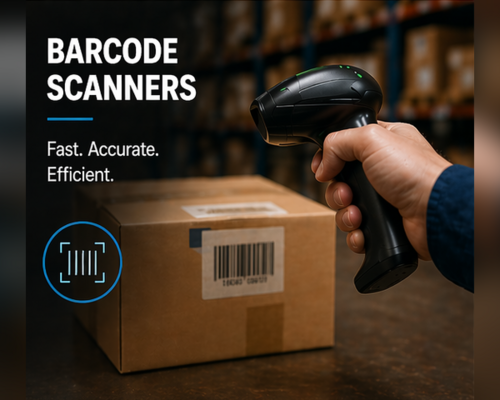
Barcode Scanners in 2026: A Practical Guide for Warehouses and Retail
Barcode scanners have quietly become one of the most strategic pieces of hardware in modern operations. Here is what actually matters when you choose one — cut through the spec sheets.
A barcode scanner is simple in principle: it reads a printed pattern and turns it into data. In practice, the device you choose today decides how fast your warehouse picks orders, how accurate your inventory is, and how quickly your checkout queue moves on a Saturday afternoon.
The technology has shifted more in the last three years than in the previous twenty. Laser scanners are giving way to AI-driven imaging. Rugged handhelds are being replaced by mobile computers that run a full warehouse app. And barcodes themselves are evolving — from the familiar 1D lines on a cereal box to dense 2D codes that carry a product's entire traceability record.
This guide is built for operations managers, IT leads, and owners who need to make the right call without reading a 40-page spec sheet. We cover scanner types, what AI actually adds, and how to match a device to your workflow.
Why barcode scanning still matters
Manual entry is the single largest source of error in most inventory workflows. Studies consistently show accuracy jumping from the low 60s to mid 90s once barcode scanning replaces typing, with receiving time cut by roughly half in well-designed warehouses.
The numbers behind the market reflect that reality. Analysts place the global barcode scanner market at roughly 9 billion USD in 2026, with steady growth into the next decade driven by e-commerce volume, automation, and compliance rules in healthcare, food, and pharmaceuticals.
The humble barcode scanner is no longer just a beep at checkout. It is the entry point where physical goods become digital data — and every inefficiency downstream starts with a bad scan.
The four scanner types, and when to use each
1. Handheld scanners
The workhorse. Wired or wireless, pistol-grip or pocket-sized, these cover retail checkout, receiving, shelf audits, and light-duty warehouse picking. A modern 2D handheld reads printed labels, phone screens, and damaged codes without complaint. If you are buying your first scanner, start here.
2. Fixed-mount scanners
Bolted above a conveyor belt or into a self-checkout kiosk, fixed scanners run without human intervention. They shine in high-throughput distribution centres and production lines where items need to be read continuously as they move past. Expect higher upfront cost, much lower cost per scan.
3. Wearable scanners
Ring scanners, glove scanners, and wrist-mounted devices free both hands for picking and packing. In e-commerce fulfilment, wearables are the fastest-growing category — they cut motion waste and reduce fatigue across an eight-hour shift.
4. Mobile computers with built-in scanners
These combine scanning, computing, and connectivity in one Android or Windows device. Workers see stock levels, confirm picks, and push updates to the warehouse management system in real time. The shift from "dumb" scanner to connected mobile computer is arguably the biggest hardware trend of the decade.
Quick rule of thumb
Retail counter: handheld 2D. Conveyor line: fixed-mount. Pick-and-pack at volume: wearable or mobile computer. Field service and delivery: mobile computer with a rugged case.
1D vs 2D: why imaging has won
A 1D (linear) scanner reads traditional barcodes — the kind on most consumer packaging. A 2D scanner reads both 1D codes and two-dimensional codes like QR, Data Matrix, PDF417, and Aztec.
A few years ago, 1D was cheaper and faster for linear codes. That advantage has largely disappeared. Modern 2D imagers are just as quick on linear codes, and they handle three things 1D scanners cannot:
- Damaged or poorly printed labels. A torn corner or a smeared print no longer stops the line.
- Screen-based codes. Boarding passes, loyalty apps, mobile coupons, proof-of-delivery on a driver's phone.
- Data-dense codes. Pharmaceutical serialization, aerospace traceability, and EU food regulations increasingly require 2D.
Unless your workflow is purely linear and cost-sensitive (say, a grocery checkout in a small shop), buy 2D. Future-proofing is cheap when you are specifying hardware you will use for five to seven years.
What AI actually adds
"AI-powered" is the marketing buzzword of the moment, and not all of it is real. Here is what machine learning genuinely does inside a modern scanner:
| Capability | What it means on the warehouse floor |
|---|---|
| Intelligent decoding | Reads damaged, low-contrast, or partially occluded codes that would fail a traditional scanner. |
| Multi-code capture | Reads several barcodes in a single image — useful when a pallet label has five codes next to each other. |
| OCR + barcode fusion | Reads printed text, handwritten numbers, and barcodes together. Critical when labels vary in quality. |
| Anomaly detection | Flags mismatched or counterfeit labels in real time rather than after the fact. |
| Drone and robot integration | Autonomous inventory audits using drones with AI scanners can cover a full warehouse overnight. |
Industry forecasts expect the majority of new barcode scanners shipped in 2026 to incorporate some form of AI-based decoding. The practical takeaway: if you are refreshing fleet hardware this year, make sure the roadmap for your chosen device includes ML-based decoding, not just a marketing sticker.
Rugged or consumer-grade?
A consumer smartphone with a scanner app works fine for a pop-up shop or a sales rep. It will not survive a cold storage warehouse, a fulfilment centre, or a loading dock.
Rugged scanners are rated for drops (typically 1.8 to 2.4 metres onto concrete), dust and water ingress (IP65 or higher), and temperature ranges that include freezer environments. They also tend to have faster, brighter imagers tuned for dim aisles and shrink-wrapped pallets.
The cost difference is real — a rugged mobile computer can run five to ten times the price of a consumer phone — but so is the lifecycle. A consumer device fails within months in industrial use; a rugged device lasts five to seven years.
How to choose: a four-question checklist
- What is the environment? Office, retail counter, warehouse, cold storage, outdoor? This sets your ruggedness and IP requirements.
- What codes do you scan? Just UPC at a checkout, or Data Matrix for pharma compliance? Mixed environments mean 2D imaging is the safe default.
- How does it connect? USB-HID into a POS is simple. Bluetooth to a tablet adds mobility. Wi-Fi plus an Android app on a mobile computer unlocks real-time WMS integration.
- Who supports it? Hardware is only half the decision. A solution partner who understands your workflow, configures the devices, and provides ongoing support will save you more than the price difference over the device lifetime.
Common mistakes we see
- Buying on price alone. The cheapest scanner often has the shortest useful life and the worst read rate on damaged labels. Total cost of ownership over five years is the number that matters.
- Ignoring software integration. A scanner that cannot talk to your ERP or WMS is a data-entry device, not an automation device.
- Standardising too early. Different parts of your operation often need different tools. Receiving, picking, and shipping each have different ergonomics.
- Forgetting the labels. A great scanner cannot rescue poor-quality labels. Label printers, ribbon choice, and print resolution are part of the same system.
Where this is heading
Three directions are clear for the rest of the decade:
- Scanning becomes ambient. Built into fridges, shelves, kiosks, and robots rather than held in a hand.
- 2D becomes the default. Expect regulators, retailers, and manufacturers to move to Data Matrix and QR for product identification and traceability.
- The scanner becomes a sensor. Dimensioning, quality inspection, defect detection — the same imager that reads a barcode will increasingly do more on the same scan.
None of this makes the humble barcode obsolete. It makes it more central. The infrastructure gets smarter; the label stays the anchor.
